
Checking Criminal History in Scranton
Start a Scranton criminal records search with the event and the record it produced. The Scranton Police Records Unit is the source for a city incident report or dispatch history. The Unified Judicial System portal is the source for public MDJ and Common Pleas docket sheets. Lackawanna County Prison can address current county custody by phone, while Pennsylvania State Police PATCH supplies a statewide repository response. One source cannot stand in for the others because each records a different stage.
- Identify Scranton Police from the citation, event location, or incident number.
- Ask its Records Unit for the specific incident, accident, dispatch, or video record.
- Search UJS at the Magisterial District Court level by name, OTN, or complaint number.
- Check Lackawanna Common Pleas and county custody channels if charges advanced or a commitment occurred.
- Use PATCH for an official state response, or SP 4-170 to review your own complete record.
Scranton Police Record Prices
Scranton publishes a useful fee distinction. An incident report costs $25, but the city waives that charge for a crime victim. An accident report costs $15. A dispatch history tied to a residence or business costs $25. These are separate products, so name the one needed instead of asking for a broad criminal history. The Records Unit files reports, enters case dispositions, compiles UCR information, and mails released copies.
| Record | Published fee | Useful detail |
|---|---|---|
| Incident report | $25; free to a crime victim | Incident number, date, place |
| Accident report | $15 | Crash date and place |
| Dispatch history | $25 | Residence or business address |
The fee does not guarantee release of each page. Investigative, juvenile, victim, and protected personal information may remain closed or be redacted.
Scranton Police Department Records
Scranton Police headquarters is at 100 South Washington Avenue. The main line is 570-348-4130 and the nonemergency line is 570-348-4134. The Records Unit is the city custodian for reports it creates. Supply the event date, time, location, involved party, and incident number when known. Those facts let staff separate a report request from a court or custody question.
The official Scranton Police Department gateway is the right place to verify current instructions. A police report records what officers received, observed, or investigated. It is not a PSP statewide history and does not establish the final result of a charge.
Scranton Criminal Record Requests
Scranton's Right-to-Know officer accepts city requests at rtk@scrantonpa.gov. A useful request identifies the record, date, place, agency, and incident number, then states whether inspection, printed copies, electronic delivery, or certification is sought. The city form offers mail, fax, email, and in-person channels. For video, include the exact date, time, place, and preferred CD or thumb-drive medium.
The Scranton Right-to-Know page explains the five-business-day initial response rule.
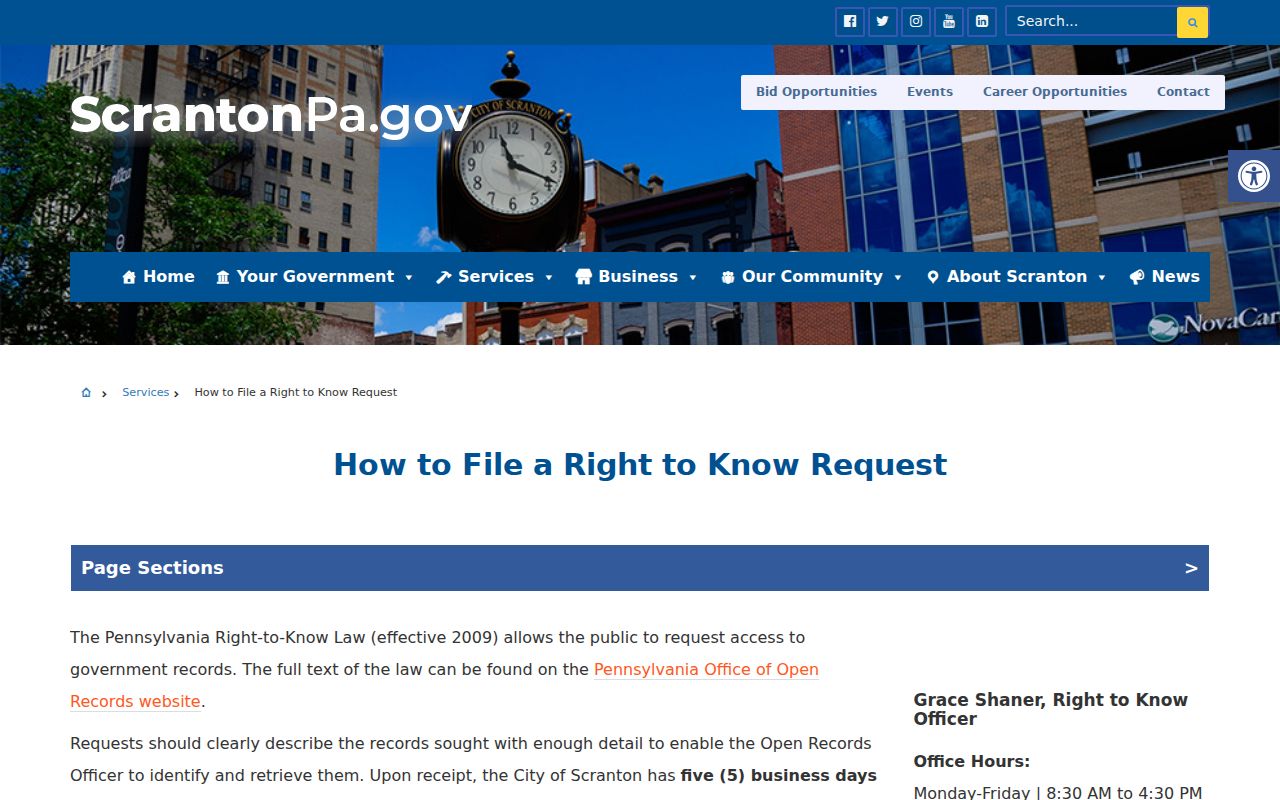
This city channel serves releasable municipal records. Judicial dockets go through the courts, and PSP histories go through PATCH.
Scranton Arrests and Bookings
Scranton Police creates the incident or arrest report, but county booking and custody records belong to Lackawanna County Prison. No verified public county inmate roster was found. Call 570-963-6639 with the full legal name and approximate booking date, then ask what custody facts staff may confirm. A police encounter may instead end in a summons, citation, release, medical transport, or juvenile process, so do not infer a booking from every report.
New charges often appear first on an MDJ docket. Search that level before assuming the case is missing. If charges are held for court, the matter receives a CP-35-CR docket in Common Pleas. The countywide Lackawanna County arrest lookup explains the full report, booking, court, and repository chain.
Find Scranton Criminal Court Districts
Scranton spans more than one magisterial district. Current offices include 45-1-02 at 130 North Washington Avenue, 45-1-03 at 1629 Pittston Avenue, and 45-1-05 at 1600 Farr Street. Their published phone numbers are 570-963-6518, 570-963-6516, and 570-963-6503. Ward and district lines can change, so use the UJS court finder rather than choosing solely from the word Scranton.
Neighborhood names such as Minooka, Green Ridge, Pine Brook, and East Mountain are cultural geography, not court boundaries. The incident address is often the key to the right preliminary docket.
Municipal Court Records in Scranton
Scranton does not operate a stand-alone municipal criminal court. Pennsylvania magisterial district judges handle complaints, preliminary arraignments, bail, preliminary hearings, summary matters, and many traffic cases. Felony and misdemeanor charges held for court move to Lackawanna County Common Pleas. Calling an MDJ office a city court can send a request to the wrong custodian.
| Court Name | Address-assigned MDJ, then Lackawanna Common Pleas when held for court |
|---|---|
| Case Types Heard | Criminal preliminary matters, summary cases, and many traffic matters |
| Case Lookup Channel | Free UJS Case Search; assigned office for paper records |
| What the Docket Shows | Complaint, bail, hearing result, charges, events, and dispositions |
| Copies & Fees | Ask the MDJ or Clerk for current copy and certification charges |
Search Scranton Criminal Dockets
The UJS Case Search works without an account for public dockets. Choose Magisterial District Courts for an early complaint or Court of Common Pleas for a CP-35-CR matter. Search by participant name, docket number, organization, OTN, or police incident and complaint number. County and filing dates can narrow a broad name.
A docket-sheet button opens a printable PDF. Read each charge and disposition, not just the caption. The PDF is an index and does not guarantee that each complaint, motion, exhibit, or order can be downloaded.
The public sheet can still connect most parts of a Scranton case. Its first blocks identify the court, status, filing date, judge, originating MDJ, OTN, complaint number, and arresting agency. Later blocks list attorneys, bail, each charge and grade, calendar events, docket entries, sentence terms, and financial assessments. Protected birth dates and other personal identifiers are suppressed. Ask the Clerk or MDJ for a document that the index names but does not provide online, and request certification when the court's official seal is needed.
Where Scranton Criminal Records Go
Scranton Police sends a filed complaint into the MDJ system. If a charge is held for court, the transcript reaches the Clerk of Judicial Records and the District Attorney files the Common Pleas information. Courts and justice agencies then report dispositions to the PSP Central Repository.
Record flow: Scranton Police › Lackawanna County Courts › Pennsylvania State Police Central Repository
Recent facts may exist in a city report before the full court path is visible. Older outcomes belong on the docket, while PATCH reflects what agencies reported to PSP. Compare OTN, complaint number, dates, and charge details when records disagree.
Those differences are normal points in the process, not automatic proof that one office made an error. An officer may record an initial allegation, the prosecutor may amend counts, and the judge may resolve each count in a different way. A person may leave custody before indexing is complete. When accuracy matters, place the police report, MDJ docket, Common Pleas docket, and PATCH response in date order. Use a certified disposition from the Clerk to support a correction request to PSP if the repository lacks the final result.
Scranton City Hall Record Context
Scranton's city government and county justice offices sit close together, but they do not share one records counter. The city maintains police and municipal administrative material. County offices maintain the prison and Common Pleas file. That distinction matters even when both destinations are downtown.
The official City Hall directory gives the municipal office context.
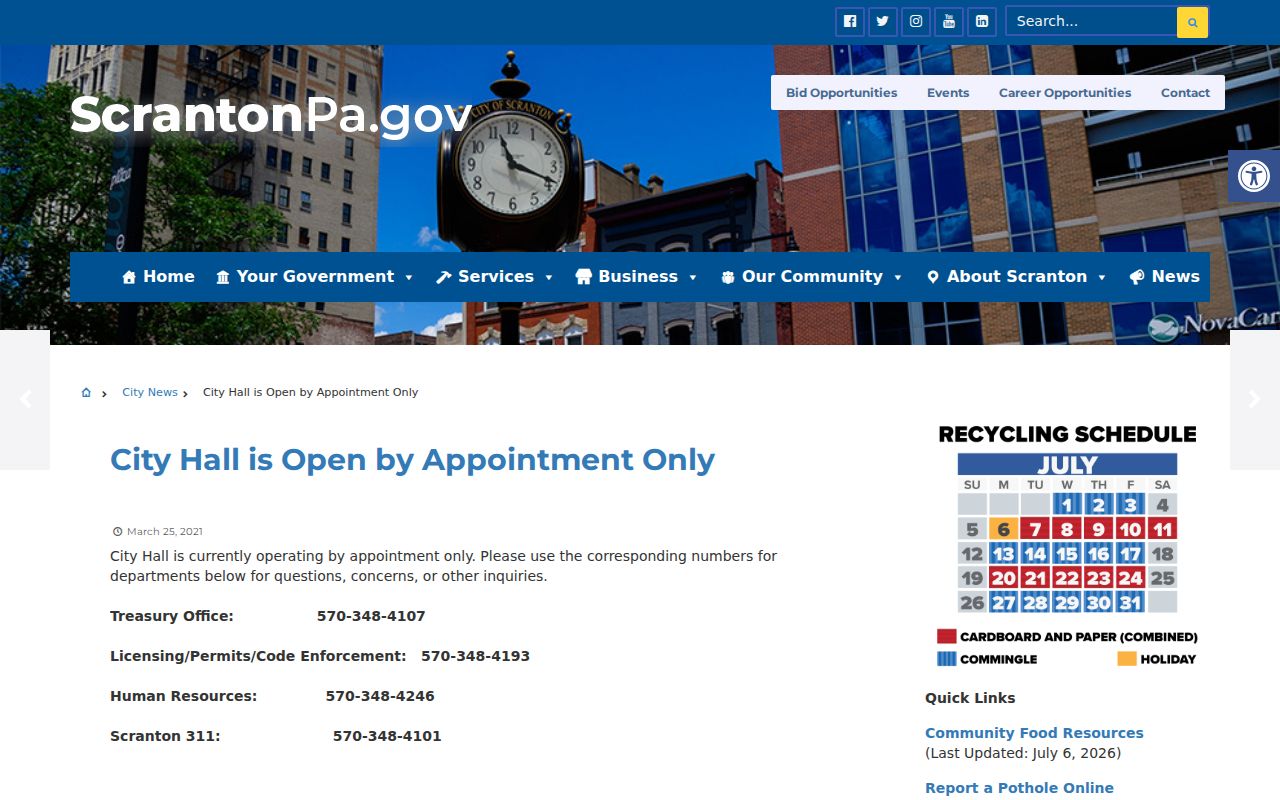
The image identifies the city source, while court papers remain with the judicial office that created them.
Scranton's own history helps explain this tight but divided geography. The city grew around iron and coal, incorporated in 1866, and became known as the Anthracite Capital of the World. Downtown developed as a hub for civic offices, while neighborhoods spread across distinct slopes and valleys. Modern record custody follows legal authority, not distance. A report made a block from a county building still belongs to Scranton Police until a court or county office creates its own file. That rule prevents a common search error: walking into the nearest government building instead of contacting the creator of the record.
The same care applies to PA UCR statistics. Select Scranton Police, enter the date range, and preserve the report generation date. Do not merge Scranton with Dunmore, Carbondale, or another agency. Participation affects the totals, so a UCR report is a measured agency snapshot, not a complete list of every event or every Scranton criminal record.
Appeal Scranton Criminal Record Denials
Scranton policy 16-016 treats investigative material, criminal-history information, and most juvenile files as restricted. A denial should state its legal basis and appeal route. Criminal-investigative record appeals from city denials go to the Lackawanna County District Attorney rather than the Office of Open Records.
The Lackawanna County District Attorney publishes its official office and units.
This route is specific to criminal investigative denials. Ordinary administrative disputes and judicial case records follow different rules.
A narrow request improves the chance of a clear answer. Describe one event, department, date span, and record component. Ask for releasable portions if the full record contains exempt material. The response should explain a denial and identify appeal rights. Do not use the city process for a Common Pleas pleading or certified disposition, because the city cannot release a judicial record it does not hold. Likewise, the District Attorney appeal route for criminal investigative material does not turn that office into the source for every Scranton Police report.
Missing Scranton Criminal Cases
A blank UJS result does not prove no event occurred. The complaint may still be at another MDJ selection, the name may use an alias, or the matter may not yet have reached Common Pleas. OTN and complaint numbers often solve name-search problems. Juvenile, sealed, expunged, limited-access, and destroyed records may be excluded from public results.
Call the assigned MDJ for a paper-record question. Use the Clerk for a Common Pleas file. A generic Scranton RTKL request is not the right escalation for a court-owned docket.
Calendar search can also reveal a scheduled hearing, arraignment, conference, or trial. Use event status and location to confirm where the next step belongs, but return to the full docket for completed events and outcomes. If the public PDF still does not resolve the question, ask the named court office for the exact paper document rather than requesting every file tied to a person.
Public Access Rules in Scranton
The Pennsylvania Right-to-Know Law presumes many city records public, but it preserves exemptions for investigations, safety, privacy, juveniles, and victim information. Judicial files use Pennsylvania court policies rather than the normal executive-agency route. CHRIA governs criminal-history dissemination.
Key Statutes:
Pennsylvania Right-to-Know Law - sets the public presumption, response time, and exemptions.
18 Pa.C.S. Chapter 91 - controls criminal-history dissemination and correction.
Pennsylvania judicial access policies - govern court files and protected personal data.
Inspect the disposition for each count. An arrest, complaint, or visible caption is not proof of conviction.